
What is customer spend analysis?
Customer spend analysis looks at how customers spend money over time. It helps banks and retailers understand purchasing behaviour, customer engagement, and long-term value. Instead of analysingindividual transactions, it focuses on customer-level spending trends.
Unlike basic sales reports, this analysis is long-term. It tracks behaviour across weeks, months, or years, highlighting consistency, growth, or decline in customer relationships.
Why is customer spend important for understanding customers?
Spending shows real behaviour. While surveys capture opinions, actual purchases reflect commitment. Customer spend analysis helps organisations answer questions like:
- How often do customers return?
- Is engagement increasing or decreasing?
- Which relationships are steady and which are temporary?
By analysing these patterns, banks and retailers can distinguish between short-term activity and long-term value. This makes spending a reliable indicator of loyalty, rooted in real behaviour rather than assumptions.
What types of customer data are used to measure loyalty?
Customer loyalty is measured using a mix of spend, behavioural, and lifecycle data. Each type provides a different insight into how customers interact with a business. While it is often considered emotional, it creates measurable outcomes: retention, repeat purchases, and long-term value.
Transactional data: shows how often customers buy, their total and cumulative spend, average order value, and how recently they made a purchase.
Behavioural data: captures patterns in repeat purchases, consistency across products or categories, and channel stability over time.
Customer lifecycle data: includes account tenure, subscription or membership duration, and retention history.
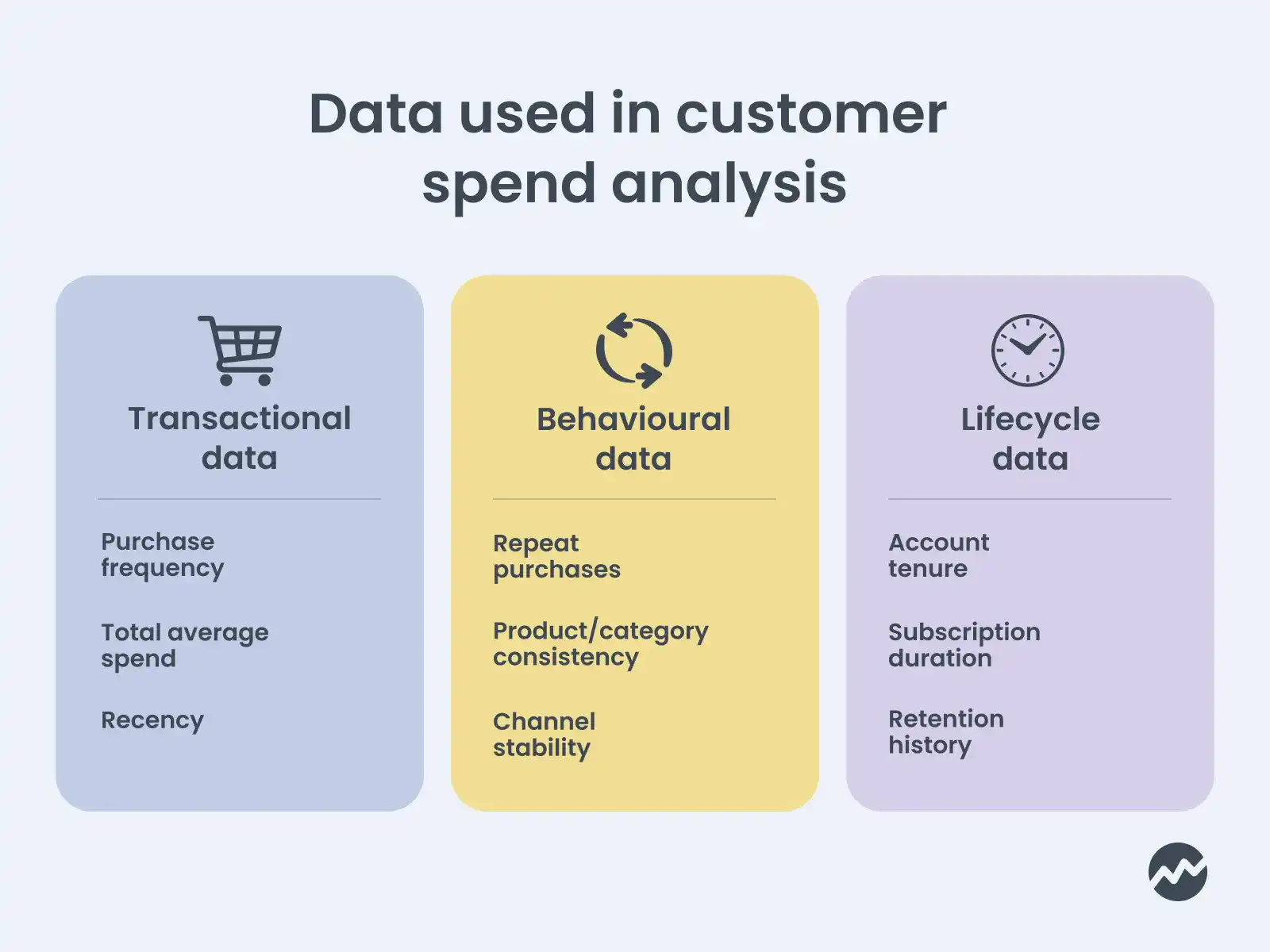
Platforms like Dateio bring these data sources together to give banks and retailers a complete picture of loyalty. And this analysis shows not just what customers buy, but how their relationships develop over time.
How do loyal customers behave differently from other customers?
Loyal customers follow consistent, repeatable habits. These behaviours set them apart from occasional buyers.
Typical traits include:
- frequent purchases sustained over long periods,
- predictable purchasing intervals,
- stable or increasing spend trends,
- higher lifetime value rather than one-time high spend,
- lower volatility in purchasing behavior.
Analysis reveals these patterns by focusing on consistency and duration rather than single transactions. It helps identify the customers who truly contribute to long-term business health.
How can customer spend analysis be used to identify loyal customers?
The analysis looks at multiple dimensions of behaviour rather than a single metric. The process usually involves:
- Aggregating spend data: Transaction data is combined at the customer level to track total spend, purchase frequency, and purchase history.
- Measuring behavioural consistency: Customers are evaluated on how regularly they purchase and how stable their engagement remains over time.
- Assessing long-term value: Cumulative spend and tenure distinguish sustained relationships from short-term activity.
- Segmenting customers by behaviour: Customers are grouped based on frequency, stability, and lifetime value patterns.
- Validating loyalty over time: True loyalty is confirmed when behaviours persist beyond short-term promotions or campaigns.
Customer analytics platforms automate this process by continuously updating loyalty indicators as new spend data becomes available.
What is the difference between high spenders and loyal customers?
High spenders make large purchases, often in a short timeframe. Loyal customers, on the other hand, buy consistently over months or years.
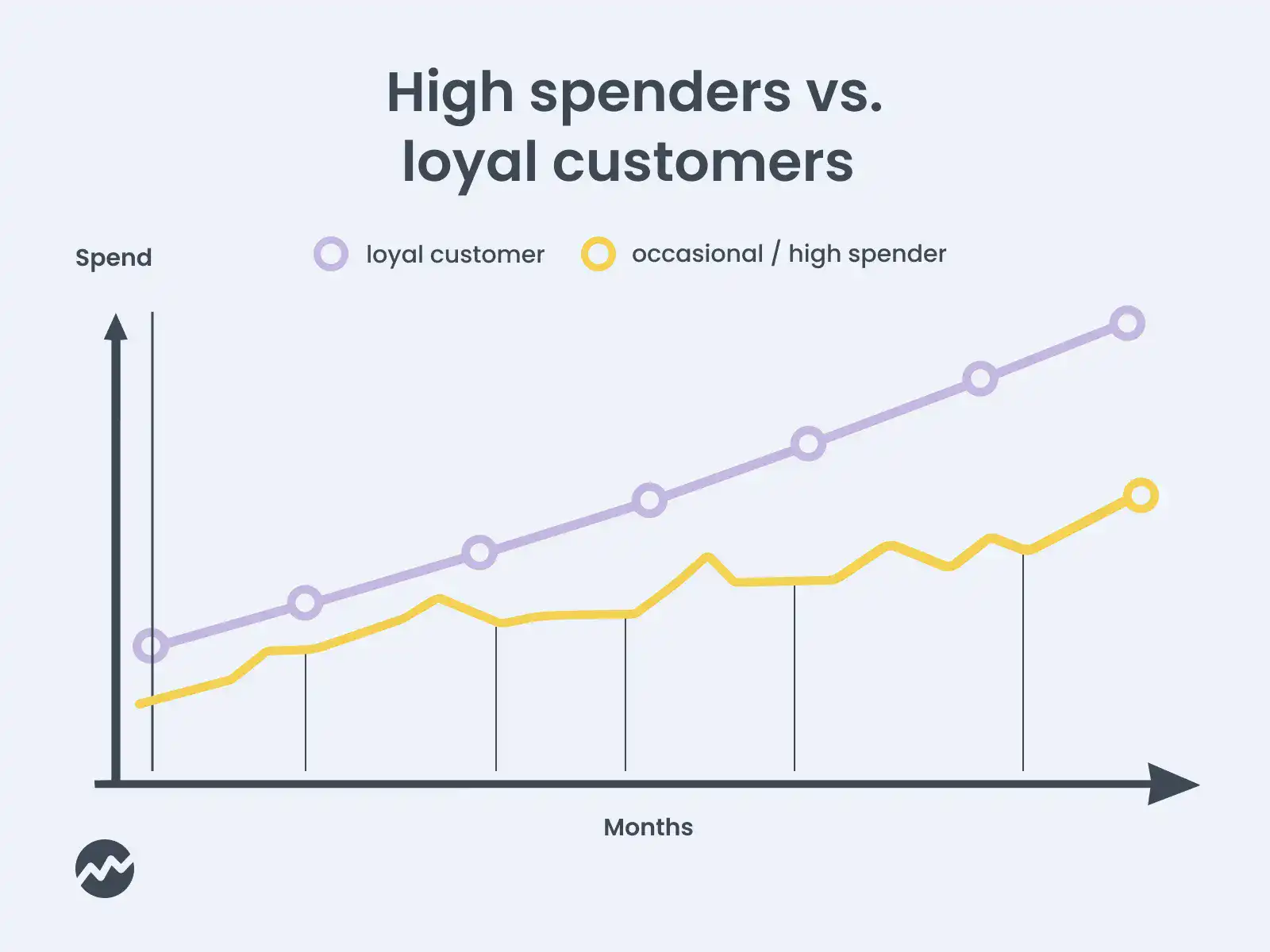
Customer spend analysis makes the distinction clear by emphasising repeat behaviour and longevity rather than transaction size alone. A one-off big spender is not necessarily loyal, while a moderate but consistent buyer often is.
Why is customer spend analysis effective for loyalty identification?
It works because it is based on observable behaviour and tied to revenue outcomes. It is scalable, repeatable, and applicable across industries.
By looking at long-term patterns instead of isolated events, banks and retailers can clearly see which customers are truly loyal and which are temporarily active. These insights support data-driven loyalty strategies and more personalised engagement.
For a broader perspective on how transaction data shapes modern loyalty strategies, see our article Customer Loyalty in the Age of Data-Driven Marketing.
FAQs
Customer spend analysis examines how customers spend over time to reveal patterns in behaviour, engagement, and long-term value.
Customer spend analysis helps identify loyal customers by tracking consistent spending, repeat purchases, and stable engagement over weeks, months, or years.
Transactional, behavioural, and lifecycle data are combined to give a full view of customer loyalty and long-term engagement.


A content creator with a passion for emerging tech companies and the startup community. She uses her background in media and PR for writing, editing, and brand building. Her mission is simple: she loves a good story, and strives to make complex topics clear and simple.
