
The retail landscape is currently obsessed with retail "loyalty" apps. Every major supermarket chain has one, and the competition to get onto the customer's home screen is fierce. But as we peel back the layers of the current grocery ecosystem, a provocative question emerges: Are these programmes actually fostering loyalty, or are they just digital life support for the traditional "leaflet war"?
The illusion of the retail loyalty app
We use the term loyalty programme out of habit, but for most retailers, loyalty isn’t the primary objective. Today’s apps serve predominantly as a communication channel for mass promotions, designed to drive short-term sales rather than long-term relationships.
The "leaflet wars" of the past have simply migrated to mobile. The goal isn’t to build a long-term bond; it’sto capture a share of the "floating spend" – that portion of the household budget that shifts from one chain to another each week based on who has the cheapest offers.
In this environment, loyalty apps rarely create a lasting competitive advantage – features are easy to replicate, and competitors quickly catch up. Recent McKinsey research supports this: true loyalty is driven by fresh food quality, private labels, and the overall shopping experience. The app itself rarely makes the top of the list.
The RFM trap: why your data might be lying
Most retailers use some variation of the RFM model (recency, frequency, monetary) to identify their "loyal" customers. On paper, it makes sense. If a customer visits twice a week, they must be loyal, right? Not necessarily.
The limitation of retailer-specific data is that it exists in a vacuum – it tells you nothing about what happens outside your four walls. Even within those four walls, the picture is incomplete, as customers don’t always use the app at every purchase.
Enter transaction-based intelligence
This is exactly where transaction-based intelligence comes in. It is bridging the gap between what a retailer sees and what a customer actually does across the entire market. When we combine our share of wallet (SoW) analysis based on card payment data with a partner’s internal RFM metrics, the results are eye-opening.
Typically, fewer than half of the customers marked as loyal by an RFM model are actually loyal by SoW. A customer might visit you twice a week but still spend 70% of their total grocery budget at a competitor. Without the full context of the "total wallet", RFM can lead to misreading not just loyalty, but also the true value and potential of a customer.
When we compare RFM segments with share of wallet, the mismatch becomes immediately visible. A meaningful share of "loyal" customers actually spends only a small portion of their total grocery budget with the retailer. At the same time, some "rare" customers turn out to be highly committed when viewed through the lens of total spend. Frequency does not equal loyalty.
Key observations
- Around 1 in 5 "loyal" RFM customers spends less than a quarter of their grocery budget with the retailer
- Around 1 in 7 "rare" customers are in fact highly loyal when measured by SoW
This gap between perceived and actual loyalty highlights a broader limitation of relying on internal data alone – something we’ve touched on in more detail in our previous article on loyalty programmes and CLOs.
The "promo trap" blocking personalisation
Many people think that shops fail at personalisation because they don’t have enough data or tech experts. In reality, the problem is the business deal between shops (retailers) and the companies that make the products (suppliers).
The industry runs on a fixed schedule of big weekly discounts. During these weeks, a supplier pays the shop to sell as much of a specific product as possible. Because the goal is to sell huge volumes, the shop "pushes" the same offer to every customer.
True personalisation would mean stopping these "one-size-fits-all" weekly sales. This would require changing a deeply embedded commercial model, not just improving technology. But for the first shop to try this, it is very risky – they might lose customers to competitors who are still offering big, simple discounts. As a result, the whole market stays locked in the same model. Because of this risk, personalisation stays a small, extra feature instead of becoming the main part of the app.
From PUSH to PULL: learning from banks
We can see a similar change in how banks have worked over the last 15 years. They moved from a PUSH model to a PULL model:
- PUSH: You have a product with a high profit (like insurance) and you try to "push" it onto every customer.
- PULL: You understand what the customer actually needs and offer them something that is truly useful to them.
This shift is driven by a simple reality: if you don’t offer something relevant, someone else will. In grocery shops, the PULL model means stop "shouting" about this week’s cheap yoghurt. Instead, the shop becomes a natural part of the customer’s daily life.
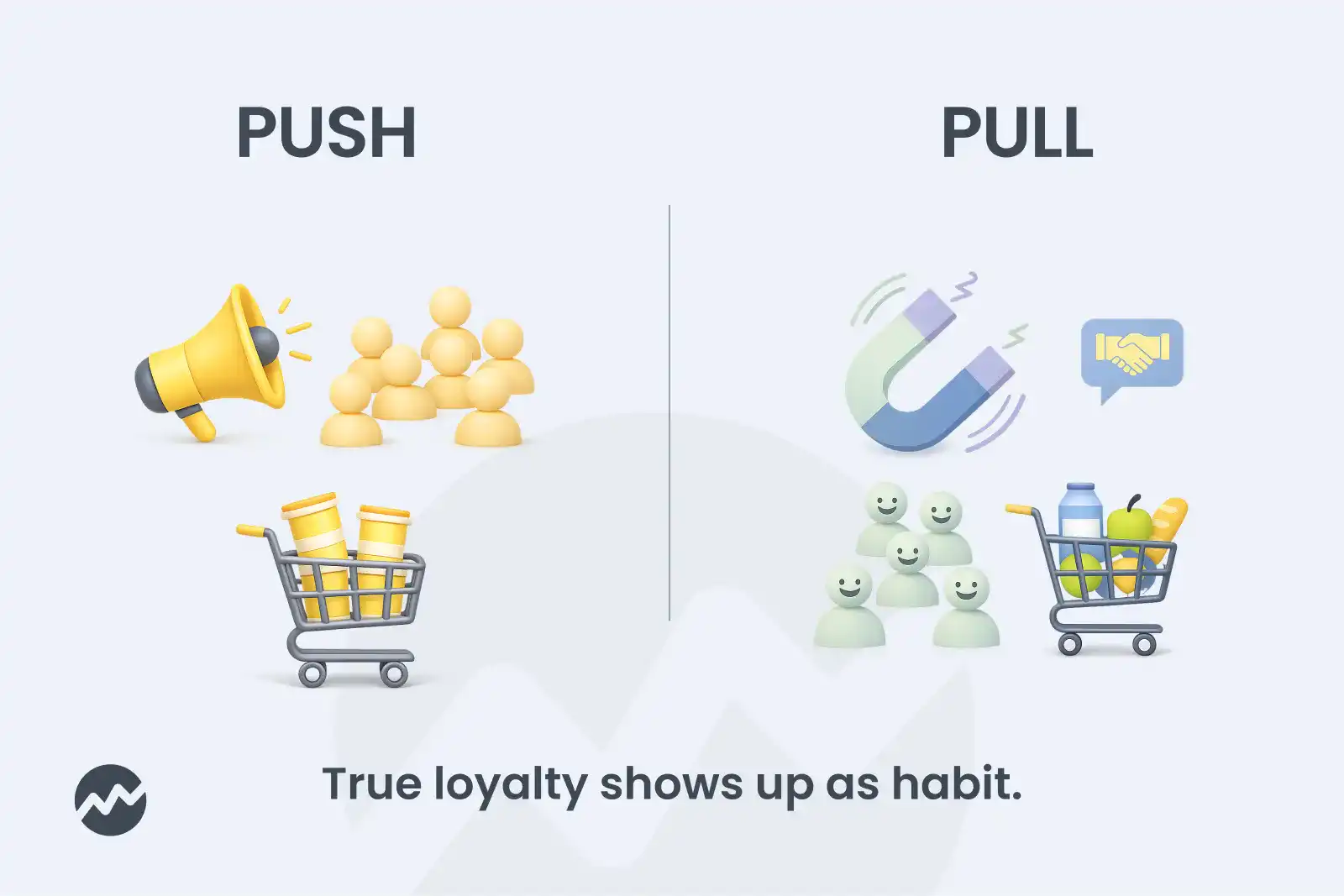
True loyalty shows up as habit – when customers return without actively comparing offers. A customer who shops with you because they trust you – not just because they have a coupon – is much more valuable in the long run.
The next big step
It is easy to be critical, but digital loyalty apps are definitely better than old paper leaflets. However, the next step is not just about making the app look better. It is about moving from "Push" to "Pull" and proving incrementality (showing that the app actually brings in new money, rather than just giving discounts to people who were going to buy the product anyway).
The loyalty programmes should not be deleted. They just need to grow. By combining the "brand feeling" of a traditional programme with the data precision of card-linked offers (CLOs), shops can stop guessing and start predicting what customers want. The real shift is from optimising campaigns to understanding customer behaviour across the full wallet. The industry must now use better testing to see if these apps are truly growing the business or just giving away profit for no reason.
FAQs


Strategic thinker and co-CEO of fintech Dateio, which he co-founded. He brings expert insight into business development, sales, and strategy, drawing on extensive experience in data analytics and managing relationships with key partners and investors. At Dateio, he is responsible for the company’s overall strategy, planning, prioritisation, and organisational development.
